HorocyclePaint on the hyperbolic plane
What does a world look like where space grows faster the farther you go?
Summary
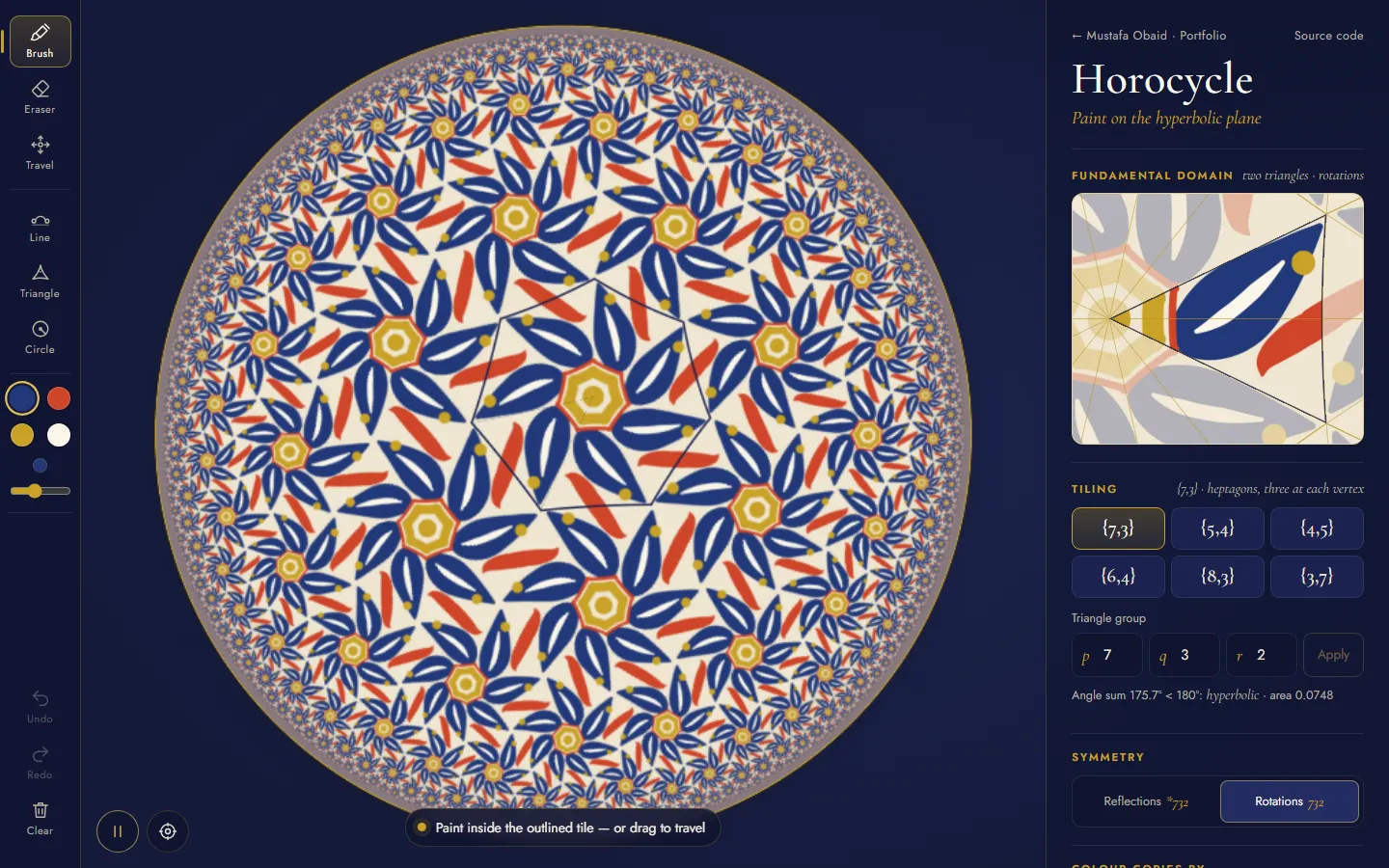
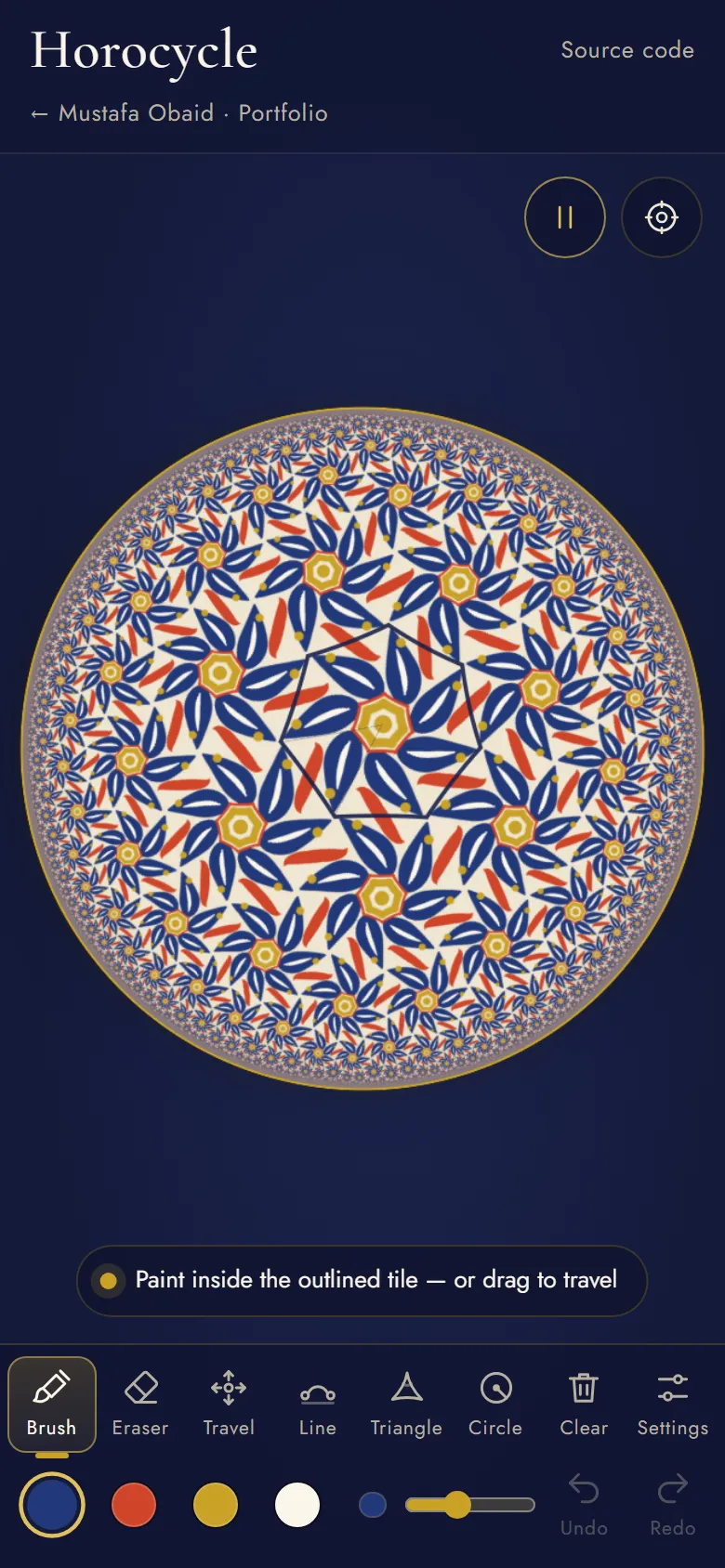
Paint one motif and watch it tile the hyperbolic plane in real time; travel through it and measure triangles whose angles add up to less than 180°.
What you can do
- Paint in one tile and the stroke appears in every tile of the infinite tiling at once.
- Six {p,q} presets or any triangle group; switch reflection and rotation symmetry and keep your strokes.
- Drag to travel through hyperbolic space with inertia; two-finger rotate on touch screens.
- Poincaré disk, half-plane, Klein and band models with morphing transitions.
- Measure geodesics, triangle angle sums and circles; export PNG up to 4096 px or share a link.
How it works
A WebGL2 fragment shader folds each pixel back into the fundamental triangle by repeated reflections across its sides, then samples the painted motif; the number of reflections gives the colouring. Travel is a Möbius isometry of the disk, re-centred on a symmetry so 32-bit floats stay accurate.
The hard part
Exact hyperbolic geometry at interactive frame rates in a shader, with painting, travel and model changes all staying consistent — verified to near machine precision.
Validation
- Isometries preserve distance (100 000 samples)
- worst relative error 3 × 10⁻¹³
- Triangle angles π/p, π/q, π/r (12 075 triples)
- 3.6 × 10⁻¹⁵ rad
- Gauss–Bonnet: integrated area vs π − angle sum
- 1.5 × 10⁻¹⁰
- Circumference vs 2π sinh r
- 2.6 × 10⁻¹⁴ relative
- Fold convergence (200 004 points)
- 0 failures