MonochordThe physics of a vibrating string
Why does a guitar sound brighter when plucked near the bridge, and a piano’s low notes slightly out of tune?
Summary
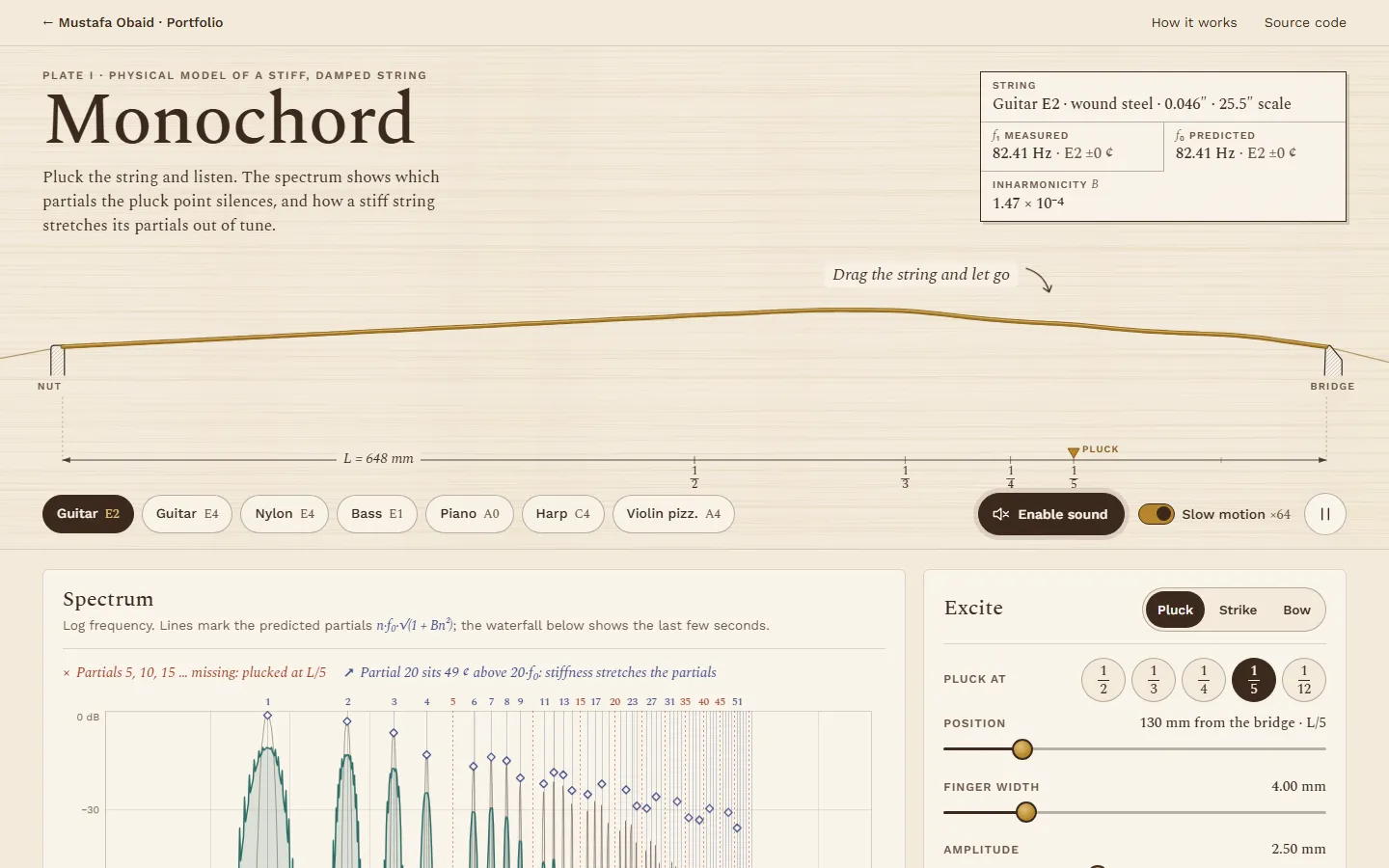
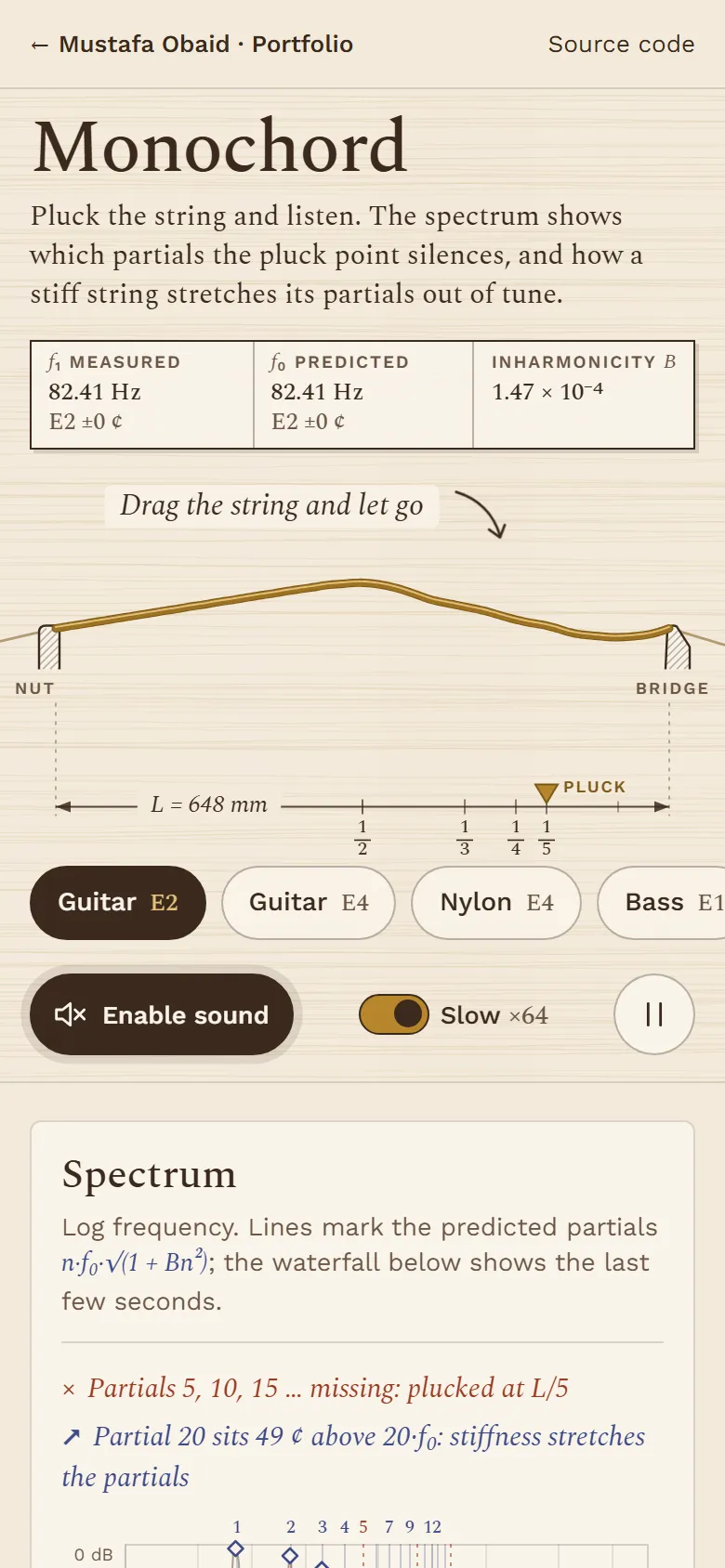
Pluck, strike and hear a physically modelled stiff string simulated at audio rate, and compare its measured overtones with theory.
What you can do
- Drag the string and let go: hear it, and watch it vibrate in slow motion.
- A live spectrum and waterfall with the predicted partials and the “missing harmonics” of the pluck point.
- Pluck, strike with a felt hammer, or bow; seven presets from published string data.
- Experiments for pluck position, stiffness, damping and pickup position, plus a two-octave keyboard.
- A table of measured versus predicted partials.
How it works
An explicit finite-difference scheme for the stiff, damped string (Bilbao) runs one step per audio sample in an AudioWorklet, right at its stability limit. The same physics module drives the sound, the slow-motion drawing, the tests and the validation script.
The hard part
Running a stable PDE solver at 48 000 steps a second on the audio thread, and showing with real numbers where it agrees with theory and where numerical dispersion appears.
Validation
- f₀ of a near-ideal string, 82–440 Hz
- within 0.005 cents of theory
- Stiff-string partials vs n·f₀·√(1 + Bn²)
- within the scheme’s own dispersion
- Pluck at L/3: partials 3, 6, 9
- 110–119 dB below their neighbours
- Lossless energy, every preset, 1 s
- drift ≤ 7.3 × 10⁻¹³
- Bowed violin, nylon and E4 strings
- Helmholtz motion, harmonics within 0.01 ¢